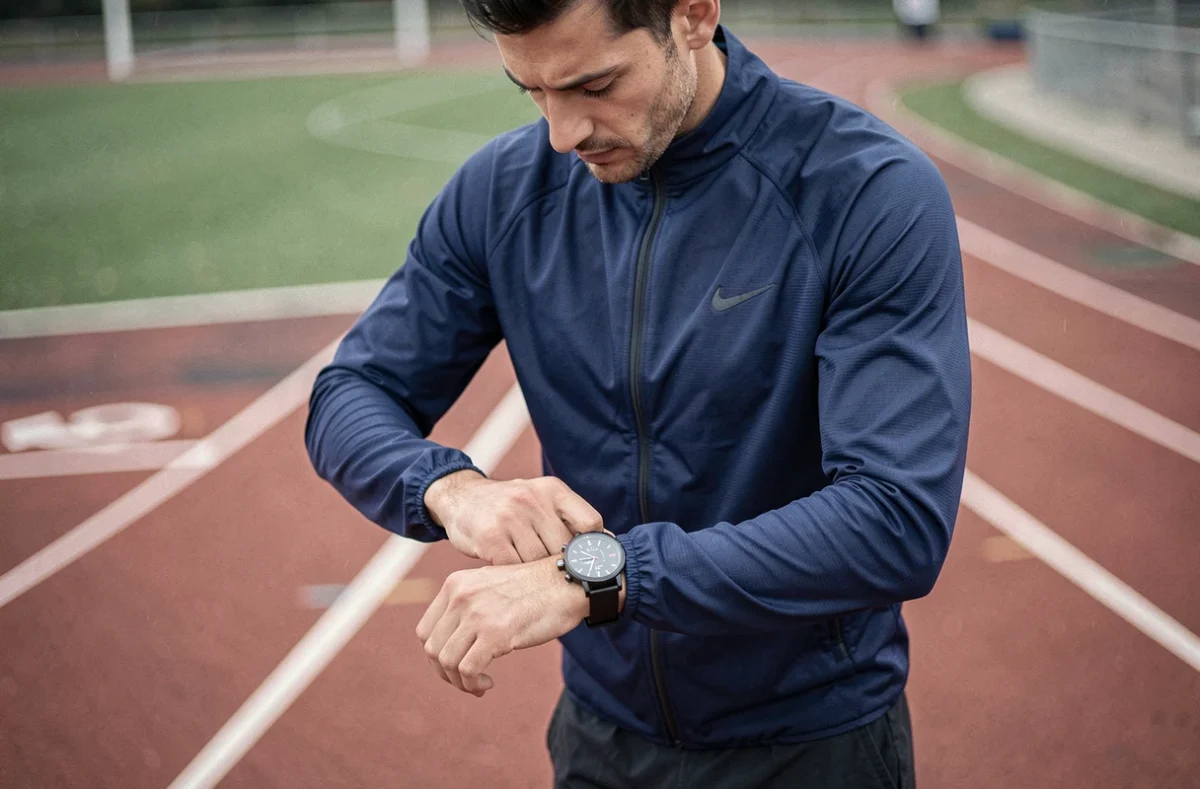
A sports stopwatch displays time to the hundredth of a second, but this resolution does not necessarily reflect the actual precision of the measurement. According to World Athletics rules, manual timing is rounded up to the nearest tenth of a second, with the hundredth reserved for fully automatic photo-finish systems. Knowing what your device actually measures is the starting point for making a suitable choice for your practice.
Displayed Accuracy vs. Actual Accuracy of a Sports Stopwatch
Most digital stopwatches sold for sports display the hundredth of a second. This granularity gives an impression of reliability, but it masks a much more determining factor: the operator’s reaction time.
Between the start signal and the button press, and then between crossing the line and the second press, the human delay introduces a margin of error that far exceeds the hundredth. For a coach timing a sprint manually, the last two digits on the screen have no usable value.
When the result is only used to compare training sessions with each other, this inaccuracy remains acceptable, provided the same triggering protocol is always followed. However, to know how to choose a sports stopwatch intended for official tests or sanctioned competitions, the method of timing takes precedence over the model of the device.
Three Methods Recognized by World Athletics
- Manual timing, with an operator and a handheld stopwatch, is suitable for training and certain authorized contexts. Times are rounded up to the nearest tenth.
- Fully automatic timing by photo-finish, triggered by the start signal, records the crossing of the line without human intervention. It is the only method that validates a hundredth of a second.
- The transponder system, used in road racing or triathlon, detects the passage of a chip worn by the athlete on a timing mat.
Before comparing models, identify which category your need falls into. A handheld stopwatch covers the vast majority of training uses, but it never replaces a certified system to validate an official time.
Synchronization with the Start Signal: The Underestimated Criterion
Classic buying guides emphasize memory, waterproofing, or backlighting. These criteria matter, but they overlook a more structural point: how the stopwatch is synchronized with the start of the effort.
A coach who starts a sprint with a whistle and then triggers the stopwatch with the other hand accumulates two sources of latency: the delay between the whistle and their own button press, and the delay between the sound and the athlete’s reaction. This double latency can represent several tenths of a second, well beyond the displayed resolution.
Adapting the Protocol to the Field
To reduce this variability, some stopwatches offer a triggering mode with an integrated sound signal. The device emits a beep and simultaneously starts the timer. The only remaining delay is that of the manual stop at the finish.
Other coaches prefer to use an external starter connected to the stopwatch via a cable or wireless signal. This type of setup approaches semi-automatic timing and improves the reproducibility of measurements without requiring a complete photo-finish system.
The choice of the start protocol influences the quality of the measurement more than the brand or price of the stopwatch itself.
Intermediate Times and Memory: Sizing According to the Typical Session
The intermediate time function (split or lap) allows for recording a time without interrupting the overall count. For interval training in running, circuit training, or evaluating multiple athletes, this capability is more useful than a display to the thousandth.
Two modes generally exist:
- The split mode displays the time elapsed since the start at the moment of pressing, then returns to the ongoing count. It is used to measure the cumulative time at each passage.
- The lap mode resets the visual counter to zero with each press while keeping the total time in memory. It is suitable for repeated sets where each interval is compared.
The memory capacity determines how many of these readings can be stored before being overwritten. For long interval sessions with about twenty intervals, a stopwatch limited to ten memories forces you to note the times on the fly, which negates part of the interest of the function.
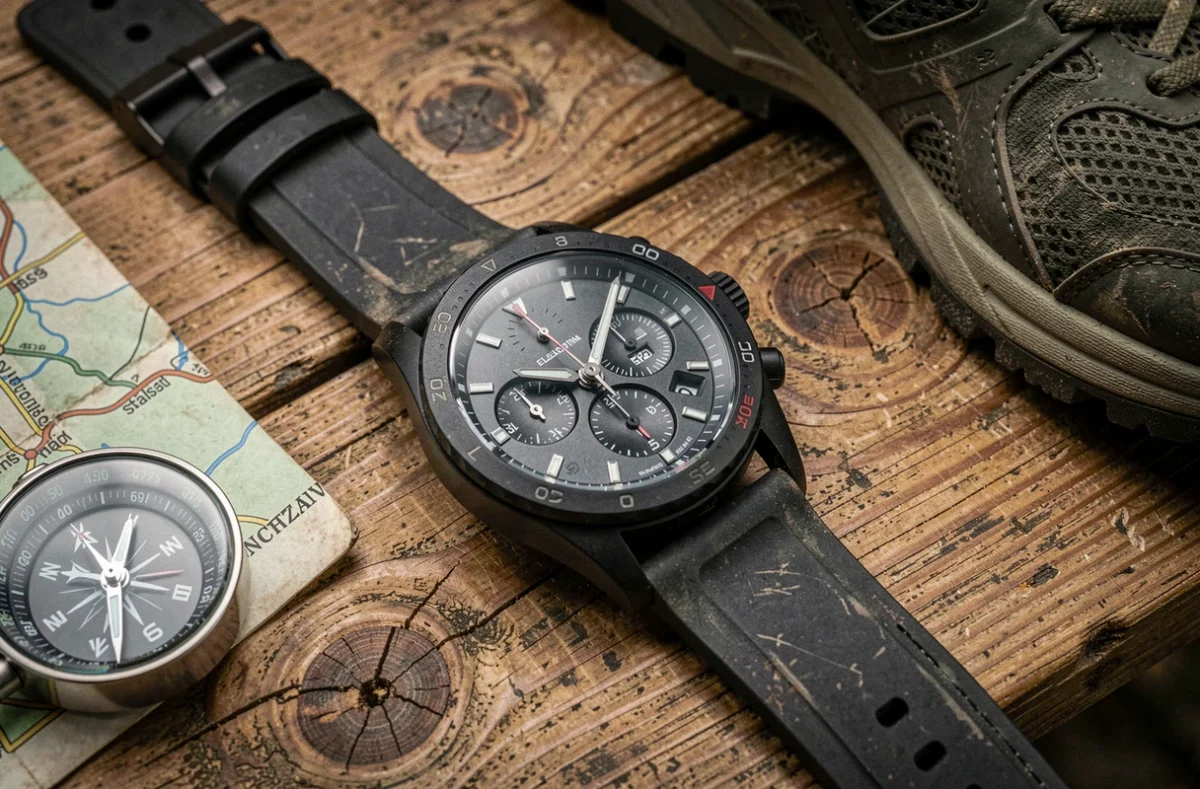
Countdown and Field Ergonomics for Timed Sessions
The programmable countdown is both an organizational tool for sessions and a measurement tool. It allows you to define the duration of an exercise or recovery time, then automatically chain them.
Some models offer a countdown repeat mode: the device restarts the count as soon as it reaches zero, with or without a sound signal. For a coach supervising a group across multiple stations, this autonomous operation frees up attention.
Readability and Handling
In bright sunlight or rain, the size of the screen and the contrast of the display are as important as the functions. A stopwatch with digits measuring a few millimeters becomes unusable at arm’s length.
The size of the buttons and their spacing also determine the reliability of the press, especially with gloves or wet hands. A button that is too small or too close to another generates manipulation errors that distort the measurement more than an electronic precision defect.
Waterproofing, often highlighted, deserves to be checked according to actual use. A splash resistance rating is sufficient for a coach on the track. A stopwatch intended for swimming or water sports requires more advanced waterproofing, with seals suitable for prolonged immersion.
The choice of a sports stopwatch is less about the technical specifications than about the suitability between the measurement protocol, the session format, and the actual conditions of use. A simple model with a good start protocol will yield more reliable results than a sophisticated device triggered at the wrong time.